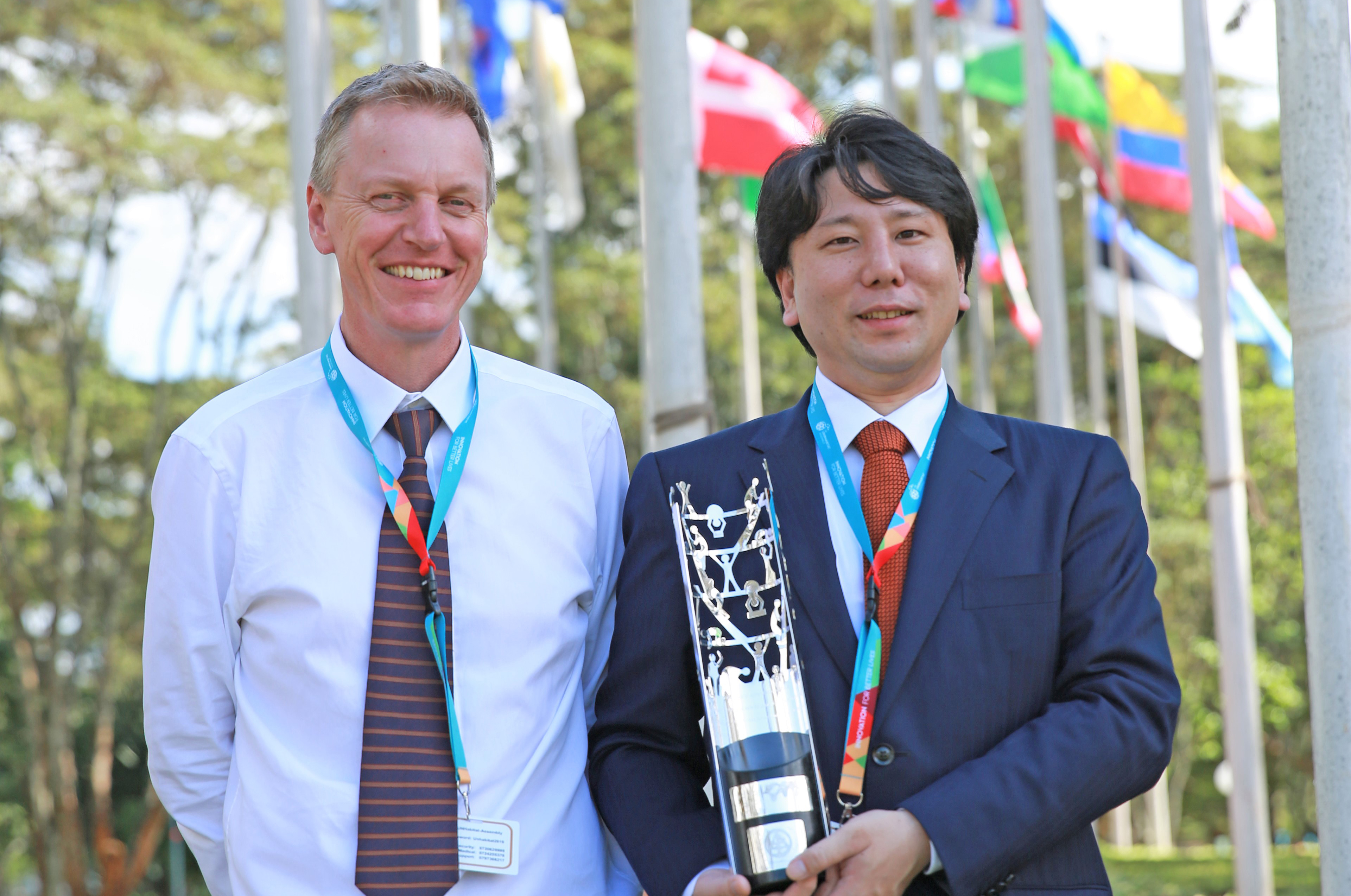
Prior to joining World Habitat as CEO, David was Chief Executive of the Empty Homes Agency where he persuaded successive UK governments to introduce legislation and fund programmes to get empty homes into use. In 2013, David was awarded an OBE in 2013 for services to housing.
Can you elaborate for our community members the key objectives of World Habitat /World Habitat Awards?
The World Habitat Awards are a long-established international housing competition that we run every year in partnership with UN Habitat. Its core purpose is to help find and communicate the very best housing practice in the world so that we can help it grow and transfer to new places where it is needed most. It continues to amaze me how many brilliant people there are out there solving big social problems. Think of any of the world’s greatest housing challenges right now; somebody somewhere has an answer and is putting it into action. The Word Habitat Awards has an extraordinary record of finding these people and their organisations and giving them global recognition.
Here are a couple of recent examples: Affordability in booming international cities is often considered too difficult to solve. But we’ve seen this year how a social enterprise in Barcelona is creating affordable homes for low income people out of abandoned properties. Remarkably they were inspired by a previous World Habitat Awards winner Giroscope from Hull in the UK.
We saw how the poorest people in rural Pakistan provided improvements for themselves such as cookers, toilets, water pumps and flood resistant homes through a system of training and self-improvement. The approach is a lesson to the world on how development needs to work. It uses the skills people already have and creates new social entrepreneurs to drive improvements which don’t consume more resources or emit more CO2.
What is the main focus of your work at World Habitat?
The organisation’s ethos is the same as the World Habitat Awards. We find what works and help it take root in new places where it is needed most. We have a number of programmes where we help this process. One of the most successful is the European End Street Homelessness Campaign. We set it up four years ago when we saw how rough sleeping was rising steeply in cities across Europe. Indeed, every country in Europe except one was experiencing an increase. That one country was Finland. We also saw some remarkable success in the USA. What we saw in both of these countries was a determination not just to reduce, but to end street homelessness. We also saw that the Housing First approach was a critical tool to achieving that aim. We took the aim and the principles we found in Finland and the USA and applied them to a diverse group of 14 cities across Europe who agreed to work with us. We are beginning to see some remarkable results, with some cities now approaching zero rough sleepers and others making important early steps in some of the most challenging circumstances.
We have other programmes too, helping establish new housing cooperatives in Eastern Europe and introducing the first Community Land Trusts to Latin America and South Asia.
Four initiatives shortlisted from previous editions of the World Habitat Awards are presented on the use platform (see: https://use.metropolis.org/world-habitat). What in your opinion are the most remarkable achievements of those projects?
I had the privilege of visiting Improvements without Barriers in Medellin. It was extraordinary, because it showed how simple small things can really transform people’s lives. It’s probably fair to say that the rights of disabled people are not always a high priority in Latin American cities. This project showed how improvements don’t have to cost lots of money. Sometimes all it takes is for somebody to take some time, to think and to care. The project made adaptations to disabled people’s homes in the poorest districts of the city. I remember visiting a family with a son with quadriplegia. The way in and out of their house involved navigating a flight of concrete steps down and then another up again. When their son was young his father was able to carry him up and down, but the son was getting bigger and his father was getting older. The family had all become trapped in the house, unable to get out and unable to leave their son on his own. The project provided a simple wooden ramp that traversed the stairwell. It changed everything. The father told me in emotional terms “It was like someone had unlocked the prison door.”
How and when can our community members submit projects for the 2020 World Habitat Awards?
The World Habitat Awards are open for submissions from the beginning of January until March 23rd. https://www.world-habitat.org/world-habitat-awards/how-to-enter/ The initial application is a simple on-line form that should only take a few minutes to complete. We may ask you for more information if you progress to later stages of the competition. The Gold winners receive a £10,000 cash prize, a trophy and are invited to an international event to receive it. This year’s winners will receive their trophies at the World Urban Forum in Abu Dhabi.