Urban heat is increasingly a health challenge. Its effects are particularly severe in low-income settlements, where densely built form, limited vegetation, poor-quality housing, inadequate public space and restricted access to cooling techniques combine to create high levels of heat exposure. At the same time, limited economic opportunities add to the health burden facing low-income communities. The solution to this double burden of disease creates a policy opportunity: urban cooling investments can be designed to reduce heat exposure while simultaneously developing skills, creating local employment and strengthening local enterprises.
use:positions
Designing Cooling Programmes to Create Employment in Low-Income Settlements
 © Pexels | Dmax-Tran
Cities should treat cooling investments as local economic development infrastructure. Residents should also be viewed as workers, entrepreneurs, producers and managers of the infrastructure that makes their neighbourhoods cooler and more resilient.
This approach is consistent with the International Labour Office’s work on climate adaptation and employment. It has shown that adaptation investments can create employment while protecting workers and incomes. At the same time, lasting effects depend on complementary policies for skills training, enterprise development and social protection. The employment-intensive green jobs approach specifically links climate adaptation, infrastructure investment, poverty reduction and employment creation, including in low-income settlement upgrading.
From cooling projects to local value chains
Different cooling measures generate different forms of economic activity. Cool roofs require assessment, roof preparation, repair, coating and maintenance. Trees and urban greens require nurseries, propagation, planting, irrigation, pruning and monitoring. Shaded public spaces can generate work in fabrication, construction, landscaping and ongoing management. Urban agriculture can combine cooling with food production, processing and local markets.
The objective should therefore be to select cooling interventions according to two criteria: their effectiveness in reducing heat exposure and their potential to generate local employment and enterprise opportunities.
This does not mean choosing an inferior cooling solution simply because it is more labour-intensive. Once technically effective interventions have been identified, employment potential should become an explicit criterion in investment design.
Cool roofs: a particularly strong entry point
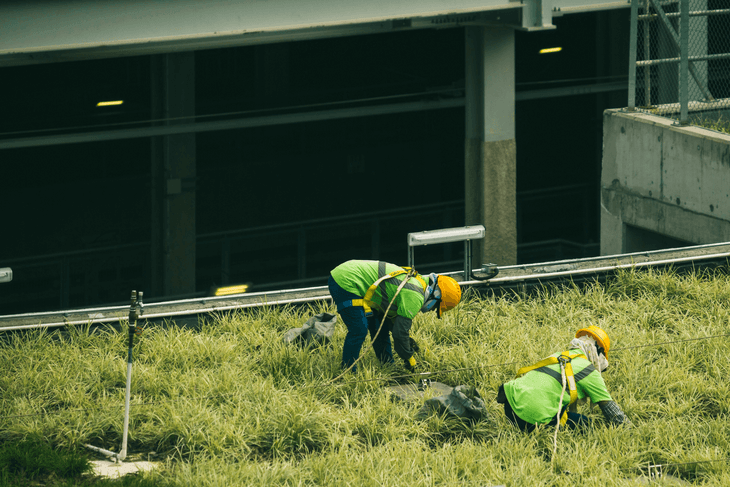
Cool roofs illustrate how a simple cooling technique can be linked directly to workforce development. New York City’s CoolRoofs programme has coated more than 5.7 million square feet of rooftops and combined reflective-roof installation with green-workforce training. The programme prioritised assistance for public, non-profit and low-income buildings. C40 reports that participating buildings can achieve cooling-cost reductions of around 10–30%.
 © Pexels | Jimbear
In dense settlements with extensive roof exposure and little available land, cooling the dwelling itself may provide some of the largest immediate benefits. Local residents can be recruited and paid to undertake roof assessment, preparation and installation, while training can provide recognised skills in roofing, building efficiency and occupational safety. Procurement can then create a pathway for trained workers to form or join local enterprises capable of undertaking future contracts.
Small-scale cooling infrastructure can create accessible local work
Low-income settlements often lack the land required for large parks. Recent research from Buenos Aires’ Barrio 20 demonstrates how small-scale, participatory nature-based interventions can improve thermal comfort in dense settlements. The interventions included trees, vertical gardens and permeable surfaces, adapted to the physical constraints of individual pedestrian passages. Modelling found substantial potential to reduce pedestrian thermal stress, particularly during heatwaves.
This points towards a useful model of “micro-cooling infrastructure”. Rather than relying exclusively on large projects, neighbourhoods can create hundreds or thousands of small work packages around pedestrian routes, schools, markets, courtyards and community facilities.
Such packages can combine trees, shade structures, permeable surfaces, rain gardens, drainage and seating. Their relatively small scale can make them accessible to local micro- and small enterprises, cooperatives and community organisations, while their cumulative impact can create a neighbourhood-wide cooling network.
UN-Habitat’s guidance on nature-based solutions in informal areas similarly stresses the need to integrate climate resilience into settlement upgrading and to account for the particular spatial, social and institutional conditions of informal areas.
In particular relation to trees, New York City’s MillionTreesNYC Training Program provides a particularly relevant precedent. It combined the objective of expanding the urban tree stock with employment training for young adults previously disconnected from the workforce.
For low-income settlements, the same principle could support a local employment ladder: community nurseries and planting teams at entry level; irrigation and tree-care workers at intermediate level; arborists and supervisors at higher levels; and eventually local enterprises providing municipal tree-management services. The emphasis should be on the entire lifecycle, from seedling production to long-term maintenance, rather than on short-term planting campaigns.
Procurement as a central policy instrument
The employment benefits of cooling will not arise automatically. Procurement design may be as important as the technology itself.
If a city invests in cooling through large contracts awarded to external companies, most of the economic value may leave the settlement. By contrast, contracts can include requirements for local recruitment, apprenticeships, local subcontracting, enterprise participation and multi-year maintenance.
This approach is consistent with the ILO’s employment-intensive infrastructure model, which promotes the use of local resources and labour in climate-adaptation works and explicitly links adaptation investment with poverty reduction and employment creation.
For example, a municipal contract for planting trees could specify not only the number of trees but also the number of workers trained, the proportion of work subcontracted locally and the requirement for multi-year maintenance. Similarly, a cool-roof programme could combine installation targets with employment targets.
From temporary jobs to decent work
Cooling solutions have significant employment potential yet many existing jobs remain temporary or project-based. Women, young people and vulnerable groups can be excluded unless barriers to training, finance and labour-market access are addressed.
Consequently, cooling programmes should incorporate a skills-to-employment pathway.
Training should be connected to actual future demand. Women and young people should be included through recruitment targets, paid training, childcare support where appropriate, access to tools and finance, and preferential procurement mechanisms.
Maintenance financed from the beginning
Long-term maintenance is perhaps the most underused employment opportunity in urban cooling. A tree that dies, a green roof that is neglected or a community garden that becomes unusable no longer provides the intended adaptation benefits. Local governments should therefore finance maintenance as an integral part of the cooling investment, rather than treating it as an optional future cost.
Multi-year contracts could pay local enterprises for tree survival, irrigation, pruning, roof maintenance, landscaping and monitoring. This changes the economic model from “jobs planting trees” to “businesses managing cooling assets.”
Such an approach also improves the value-for-money of climate investment because employment becomes linked to the continued performance of the adaptation asset.
Protecting existing livelihoods
There is a second employment dimension that policy makers should consider. Cooling does not only create new jobs. It can protect existing jobs and productivity.
Outdoor workers, street vendors, construction workers, waste collectors, transport workers and other heat-exposed workers can lose working hours or income during periods of extreme heat. Consequently, cooling investments should target not only residences, but also locations where large numbers of people work or travel to work: markets, transport interchanges, pedestrian routes, construction areas and commercial streets. This makes cooling a form of productive infrastructure, not simply environmental infrastructure.
A policy framework
The guiding policy principle is simple:
Every major urban cooling investment in a low-income settlement should be designed protect people from heat and to strengthen the local economy.
International cases mentioned before suggest that this is achievable. A transformative approach is not to ask how many jobs a cooling project creates after it has been designed, but to design the cooling programme from the outset so that local employment, skills, enterprise development and proper working conditions are built into the investment model. In low-income settlements, this can turn urban cooling from a narrowly protective intervention into a pathway towards healthier settings, stronger local economies and greater climate resilience.
Dr. Edmundo Werna is a senior urbanist with more than 35 years of experience in urban development and environmental issues, with a particular focus on governance, livelihoods, health and housing. He joined the International Labour Office (ILO) in 2004, where his work included supporting the Habitat III process and partnerships with cities, international organisations and business networks. He is currently transitioning from the ILO to the School of the Built Environment and Architecture at London South Bank University.
Werna holds a PhD in urban development from the University of London and has taught and conducted research at universities in Europe and Latin America. He has published eight books, alongside numerous chapters and academic articles.
This article was written during Edmundo Werna´s visiting fellowship in CEFAVELA (Centre for Favela Studies), UFABC (Federal University of ABC). He thanks Jeroen Klink and Rosana Denaldi for their comments and suggestions on the manuscript. Jeroen and Rosana are also thanked as Director and Deputy-Director of CEFAVELA, for their support in making the visiting fellowship possible and for hosting the author. The contribution of FAPESP in funding of the fellowship is also acknowledged. The usual disclaimers apply. 