Sustainable Development Goals
Cuenca
City Government, National Government, Supranational / Intergovernmental Institutions, Community / Citizen Group, Public Utility, Research Institutes / Universities
Whole City/Administrative Region
2022 - 2025
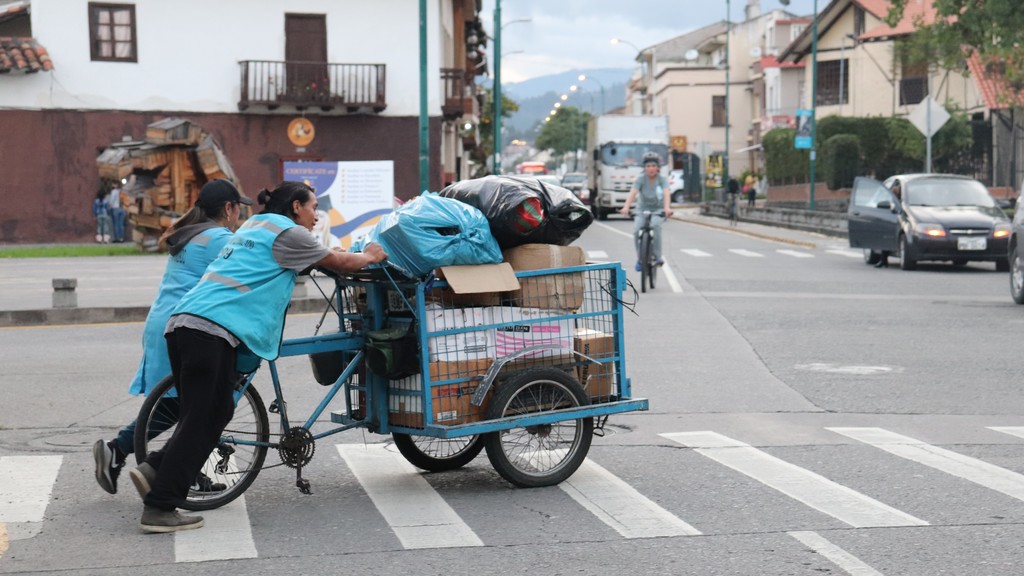
RUMBOS was a participatory action research project addressing the precarious working and health conditions of women waste pickers ("recicladoras") in Cuenca, Ecuador. Led by the University of Cuenca's Interdisciplinary Department of Space and Population (DIEP), the project combined biomedical, socioeconomic and mobility research with gender-transformative, co-designed strategies.
Activities included community validation workshops, health interventions (including a vaccination campaign and health strategy for 40 waste pickers), environmental education training, urban collection device prototypes, and a public awareness campaign ("Meet your recycler in your neighbourhood") reaching over 800 households. The project supported the formalisation of a women-led recycling cooperative (COOPCOAMA) and contributed to a proposed Municipal Ordinance on Inclusive Recycling. Results included improved health service access (55.6% to 67.5%), six commercial agreements signed by COOPCOAMA, 32 roundtable sessions, and a public exhibition reaching over 9,000 people. The project ran from September 2022 to March 2025 and was part of the broader Women RISE initiative, also covering Macas and La Libertad.
Although recycling is essential to Cuenca's waste management system, the work of grassroots recyclers has historically received limited formal recognition. Recyclers often work in precarious conditions and face occupational health risks, insecure incomes, limited access to health and social protection, and barriers to participation in public decision-making. Women are the majority of recyclers and also carry a greater share of unpaid domestic and care work. The available sources report that the average income of recyclers is below Ecuador's basic minimum wage.
The COVID-19 pandemic intensified these structural vulnerabilities. The RUMBOS project also identified gaps in urban and health policies, organisational structures and opportunities for economic empowerment in the recycling sector. Its work in Cuenca formed part of a wider project covering Cuenca, Macas and La Libertad.
The project's general objective was to improve the working and health conditions of women recyclers through participatory action research and gender-transformative strategies. Its specific objectives were to:
Assess how social determinants of health, productive and reproductive work, and public policies affect the lives and health of women waste pickers.
Co-design inclusive, intersectoral and gender-responsive strategies and policies with RENAREC, MIES, local governments, recycling organisations and other partners.
Implement strategies that improve health and working conditions at individual and organisational levels.
Strengthen the recognition, participation and economic empowerment of women recyclers within the circular economy framework.
The RUMBOS project was implemented by the Interdisciplinary Department of Space and Population (DIEP) at the University of Cuenca, using a mixed-methods approach combining quantitative and qualitative research with participatory action research. Women waste pickers participated throughout the process, including in diagnosis, data collection, validation, co-design and public dissemination. The work was organised in several overlapping phases.
Diagnosis and territorial research
The first phase, from late 2022 to early 2023, established an interdisciplinary diagnosis of health, work and mobility conditions in Cuenca, Macas and La Libertad. In Cuenca, the team used socioeconomic surveys, anthropometric measurements, clinical laboratory tests, GPS tracking, travel diaries and mobile ethnographies. The research also included ergonomic assessments of work postures and tasks using REBA, NIOSH, EPR and KUORINKA methods. The project identified high ergonomic risks in the tasks assessed, including prolonged and uncomfortable postures, repetitive upper-limb movements and the handling of heavy loads.
The qualitative work followed recyclers during their working days and documented their routes, support networks, care responsibilities and everyday obstacles. The project used interviews with waste pickers, association leaders, municipal authorities and other public policy actors to understand working, living, organisational and political conditions. The research identified a lack of institutional and legal recognition, as well as the health and social consequences of overwork, self-exploitation, limited rest and the double burden of paid recycling and unpaid household work.
Socialisation and community validation
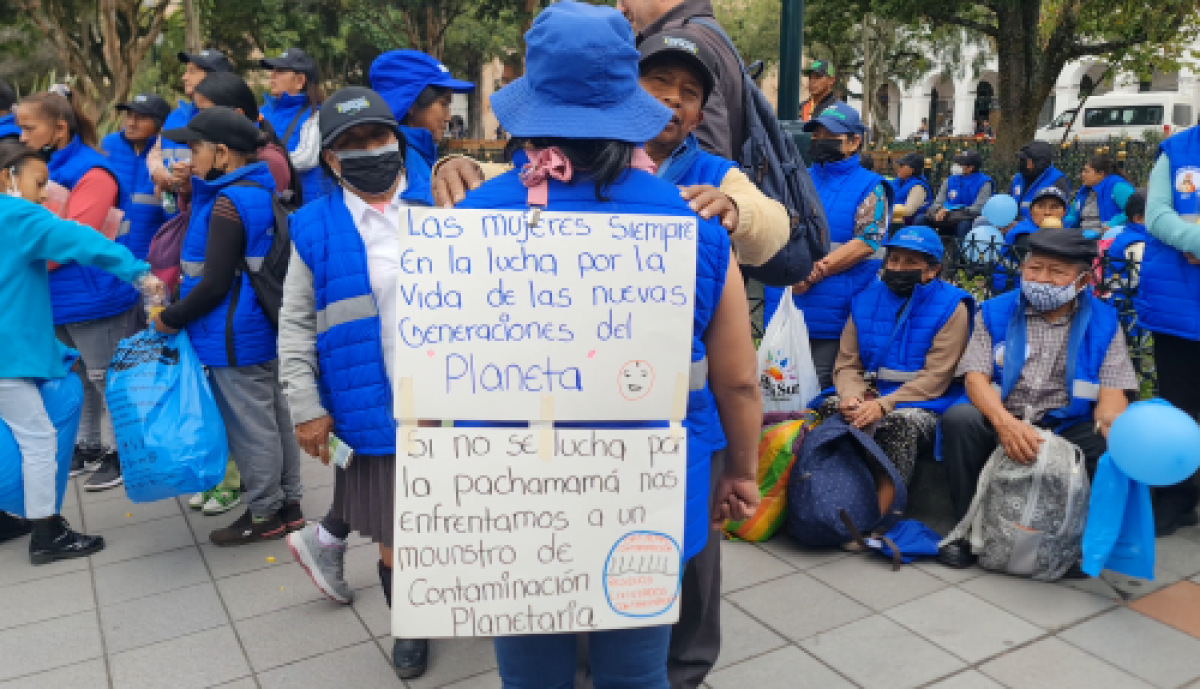
From April to September 2023, the project returned research findings to the participating communities. In Cuenca, four community workshops brought together more than 100 municipal recyclers and technicians to validate findings on mobility, health and occupational risks and to discuss health, inclusive urbanism and labour rights. The project treated this process as a form of knowledge democratisation and political participation rather than as a purely administrative dissemination exercise.
Co-design and implementation of strategies
From October 2023 to September 2024, the project moved from diagnosis to action. In Cuenca, the partners organised health activities, a vaccination campaign and the distribution of food kits. A health care strategy was developed for 40 waste pickers. Twenty waste picker leaders were trained as environmental education agents, and the project supported four prototypes of urban collection devices and three participatory urban interventions.
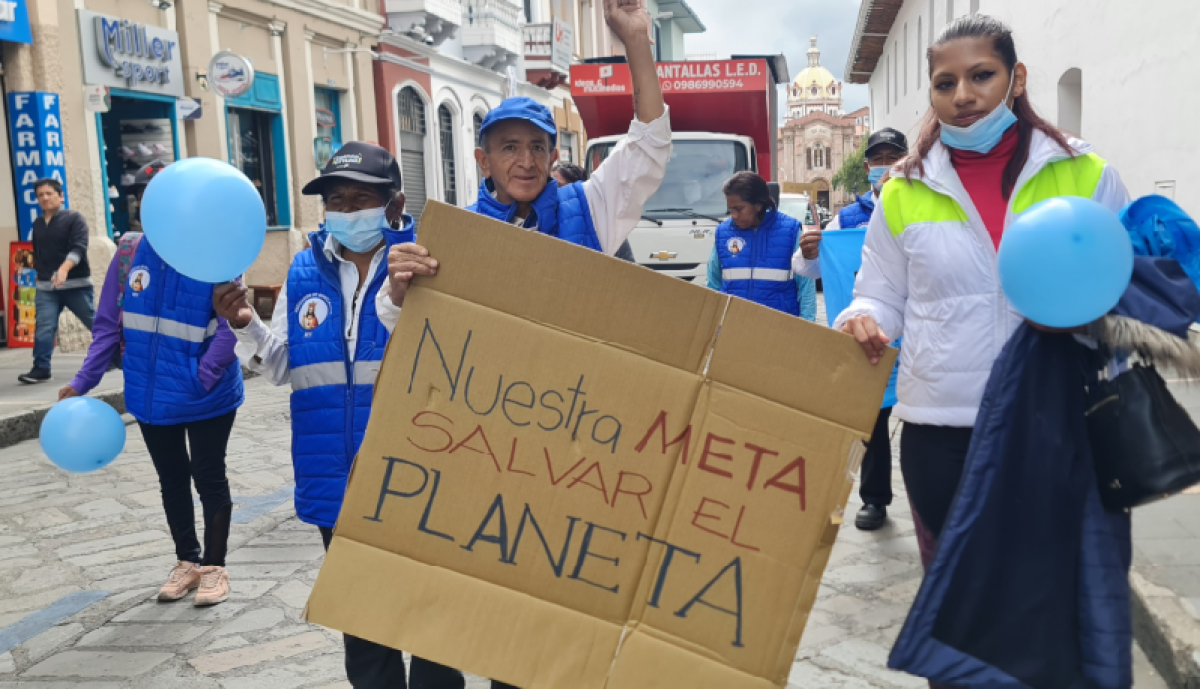
The programme “Meet your recycler in your neighbourhood” connected recyclers with residents in densely populated areas. The programme reached more than 800 households. The intervention aimed to improve public recognition of recyclers and strengthen relationships between recyclers and residents.
The project also supported the formalisation of a recycling cooperative, the Cooperative of Environmentally Friendly Recycling Services, COOPCOAMA. The cooperative was created with female leadership and was recognised as the productive arm of RENAREC South. The project team provided legal, technical and operational support, including work on governance, infrastructure, marketing and commercial agreements.
Governance, public policy and visibility
The project strengthened the Cantonal Table for Inclusive Recycling as a forum for continuing dialogue between recyclers, municipalities and private actors. It also contributed to a proposal for a Municipal Ordinance on Inclusive Recycling. The proposal was developed with waste pickers, RENAREC and local authorities and included issues of labour rights, institutional recognition, occupational health, gender equality, access to public services and participation in decision-making.
The final phase, from October 2024 to March 2025, focused on sustainability, institutionalisation and the transfer of capacities to local actors. In Cuenca, the project organised the public exhibition “Women in their Life: Invisible Trajectories”, which the report states reached more than 9,000 people. The project also continued strengthening the Cantonal Table and disseminating its findings through publications, a website, visual materials and interactive data tools.
The project was funded through the Women RISE initiative, with support from the International Development Research Centre (IDRC), the Canadian Institutes of Health Research (CIHR), the Social Sciences and Humanities Research Council (SSHRC), and the Vice-rectorate for Research of the University of Cuenca.
The University of Cuenca led the research and implementation process in collaboration with McMaster University, RENAREC, RENAREC SUR, the GAD Municipal de Cuenca, EMAC EP, MIES, local health and social institutions, recycling associations, civil society organisations and other academic partners. Resources supported biomedical, socioeconomic and mobility research; community workshops; health and training activities; organisational strengthening; urban prototypes; public exhibitions; communication materials; and technical support for the cooperative and public policy processes.
The RUMBOS project (project ID 110032) received total funding of CAD 981,240. The project was implemented by the Interdisciplinary Department of Space and Population (DIEP) of the University of Cuenca as the lead institution, in collaboration with McMaster University, under the Women RISE initiative. Women RISE was co-funded by the International Development Research Centre (IDRC), the Canadian Institutes of Health Research (CIHR), and the Social Sciences and Humanities Research Council (SSHRC). The University of Cuenca also provided institutional support and in-kind contributions through research personnel, institutional infrastructure, administrative support, and operational resources.
Following the conclusion of the RUMBOS project, various organizational and collaborative initiatives established or strengthened through the project have continued beyond its implementation period. The University of Cuenca remains actively involved in the Cantonal Recycling Roundtable, contributing to dialogue and collaboration among local stakeholders. However, the University no longer allocates specific financial resources to maintain the Cantonal Roundtable, COOPCOAMA, health-related activities, or other post-project actions initiated through RUMBOS. Consequently, the continuity of these initiatives depends on the ongoing commitment of the Ecuador Recyclers' Network (RENAREC), participating organizations, municipal and institutional programs, and the capacities of recyclers' organizations and other local partners.
The project produced results at individual, organisational, institutional and community levels:
In Cuenca, access to health services increased from 55.6% to 67.5% in the project reporting period. The project also organised health activities and established agreements with specialised institutions.
COOPCOAMA was legally constituted, signed six commercial agreements, sold more than 4.3 tonnes of recycled material, adapted a collection centre and developed a marketing plan with the University of Cuenca.
The project organised 32 work sessions of the Cantonal Roundtable for Inclusive Recycling, held five co-design workshops with authorities and recyclers, and linked more than 15 public and private institutions.
The project contributed to a proposed Inclusive Recycling Ordinance, which was delivered to the Cantonal Council of Cuenca and was in the analysis phase at the time of the final report.
More than 20 waste picker leaders were trained as environmental education agents, and the project delivered more than 25 courses on gender, cooperativism, leadership and care.
In 2022, recyclers reported recovering 1,285.22 tonnes of material. This is estimated to have avoided 7,519 tonnes of CO2e emissions.
The public exhibition “Women in their Life: Invisible Trajectories” reached more than 9,000 people and helped make the work of women recyclers more visible.
GPS tracking, ethnography and co-design generated new evidence on daily mobility, including average journeys of 7 km, loads of around 100 kg and obstacles encountered in public space.
The project was implemented in a context of political conflict, insecurity and social vulnerability. The security crisis, particularly in La Libertad, required changes to work plans and the prioritisation of participant and team safety. The project also adapted its fieldwork, meeting arrangements and allocation of ethnographic work to reflect differences in population size, organisation and security conditions across the three territories.
Other challenges included limited trust among recyclers, the need to respect their work and meeting schedules, weak organisational structures, limited access to technology, incomplete records of incoming and outgoing materials, and reluctance to share information because of mistrust. The research also identified legal gaps and a lack of institutional recognition for recycling work.
Internally, the interdisciplinary approach required continuous coordination between teams and components. The project found a need for stronger governance and communication between strategic partners and for more face-to-face exchange between local and international partners.
RUMBOS demonstrates the value of combining research, organisational strengthening, public policy work and practical action. The project identified several factors that supported implementation:
Treat women recyclers as experts and decision-makers rather than only as research participants.
Use participatory action research to generate evidence that is relevant to local working and living conditions.
Mainstream gender and intersectionality throughout diagnosis, implementation and evaluation.
Combine health, ergonomics, mobility, care, economic empowerment and political participation rather than treating them as separate issues.
Build local and inter-institutional capacities so that actions can continue beyond the funded project.
Adapt schedules, methods and fieldwork to local security conditions and the realities of recyclers' work.
Link community knowledge with public policy processes, organisational development and public communication.
The approach is potentially transferable to other cities with informal or grassroots recycling sectors. Transfer would require cooperation between recyclers' organisations, municipal authorities, universities, health institutions and civil society. It would also require sufficient time to build trust, participatory methods, flexible implementation arrangements and support for local organisational capacity. The Cuenca experience suggests that recognising recyclers as environmental workers and political actors can support both social justice and circular economy objectives.
Final Technical Report Women Waste Pickers and Inclusive Recycling in Ecuador: Gender-transformative strategies for health and economic empowerment (April 30, 2025)
International Institute for Environment and Development. (2024, 14 February). Cuenca: Recycling and decarbonisation through a gender lens. https://www.iied.org/cuenca-recycling-decarbonisation-through-gender-lens
Interdisciplinary Department of Space and Population, University of Cuenca. (n.d.). RUMBOS. https://diep.ucuenca.edu.ec/rumbos/
RUMBOS project website. (n.d.). RUMBOS project website. https://multimodal.kaleidos.ec/
University of Cuenca. (2025, 30 April). Women waste pickers and inclusive recycling in Ecuador: Gender-transformative strategies for health and economic empowerment (Final technical report, IDRC Project Number 110032). https://hdl.handle.net/10625/64589
The Map will be displayed after accepting cookie policy


