© Philipp Böhme

Graefekiez: Reclaiming Street Space, Step by Step

Status
ongoing
50%
City

Berlin

Main actors

Local Government, City Government, Regional Government, NGO / Philanthropy, Public Utility, Research Institutes / Universities

Project area

Neighborhood or district

Duration

Ongoing since 2022

Berlin's Graefekiez is gradually reclaiming selected parking spaces for greener, safer and more usable public space. The project combines de-sealing, shared mobility, improved delivery access and community engagement to reshape a traffic-calmed neighbourhood step by step.

The Graefekiez is a densely built inner-city neighbourhood in Berlin's Friedrichshain-Kreuzberg district, with approximately 30,000 residents per km². In 2023, the district assembly resolved to convert car parking spaces to other uses in a pilot project. The motto was "Step by Step, More Space". The aims were to improve road safety for schoolchildren, advance climate resilience, and create dedicated loading zones and shared-mobility hubs.

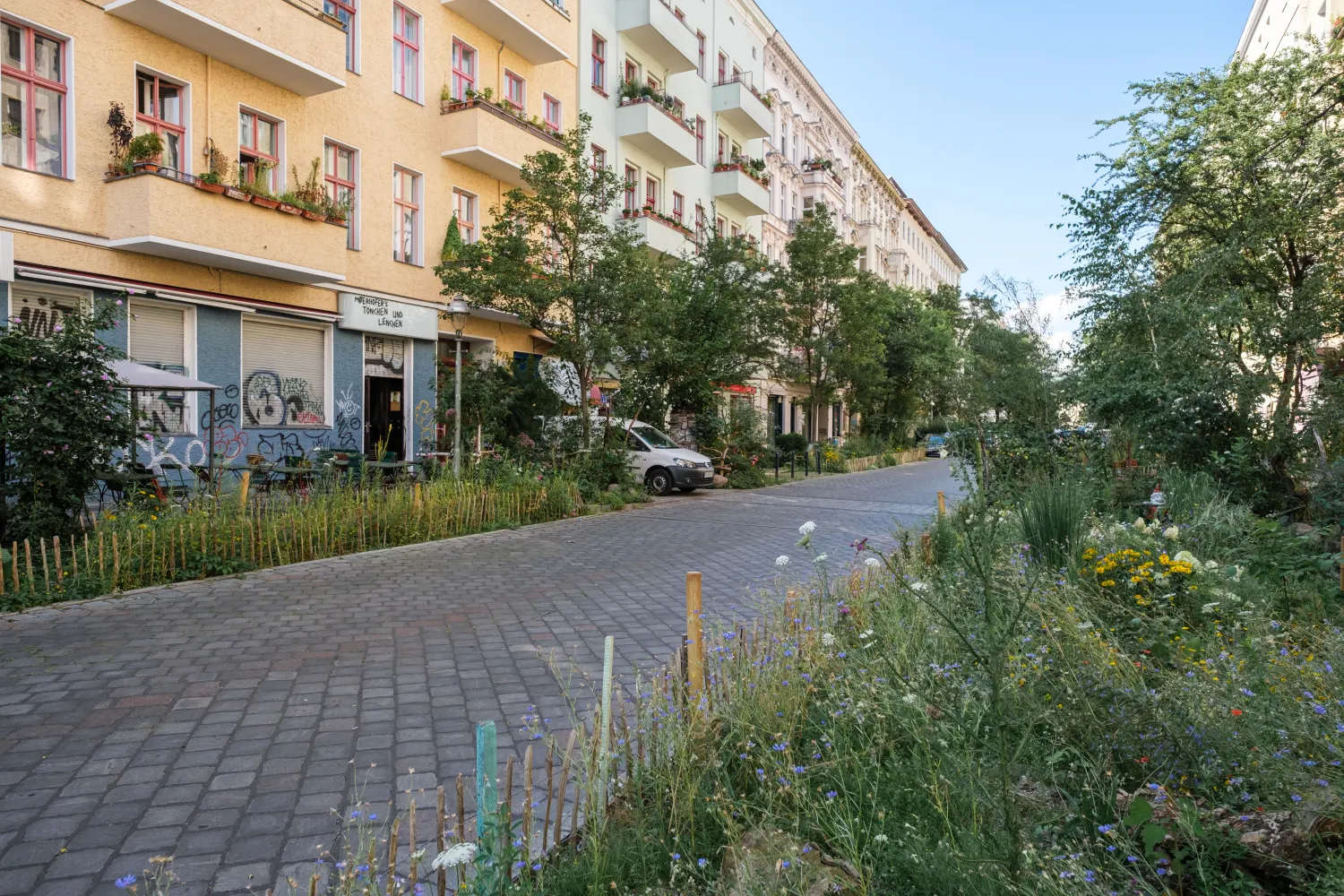
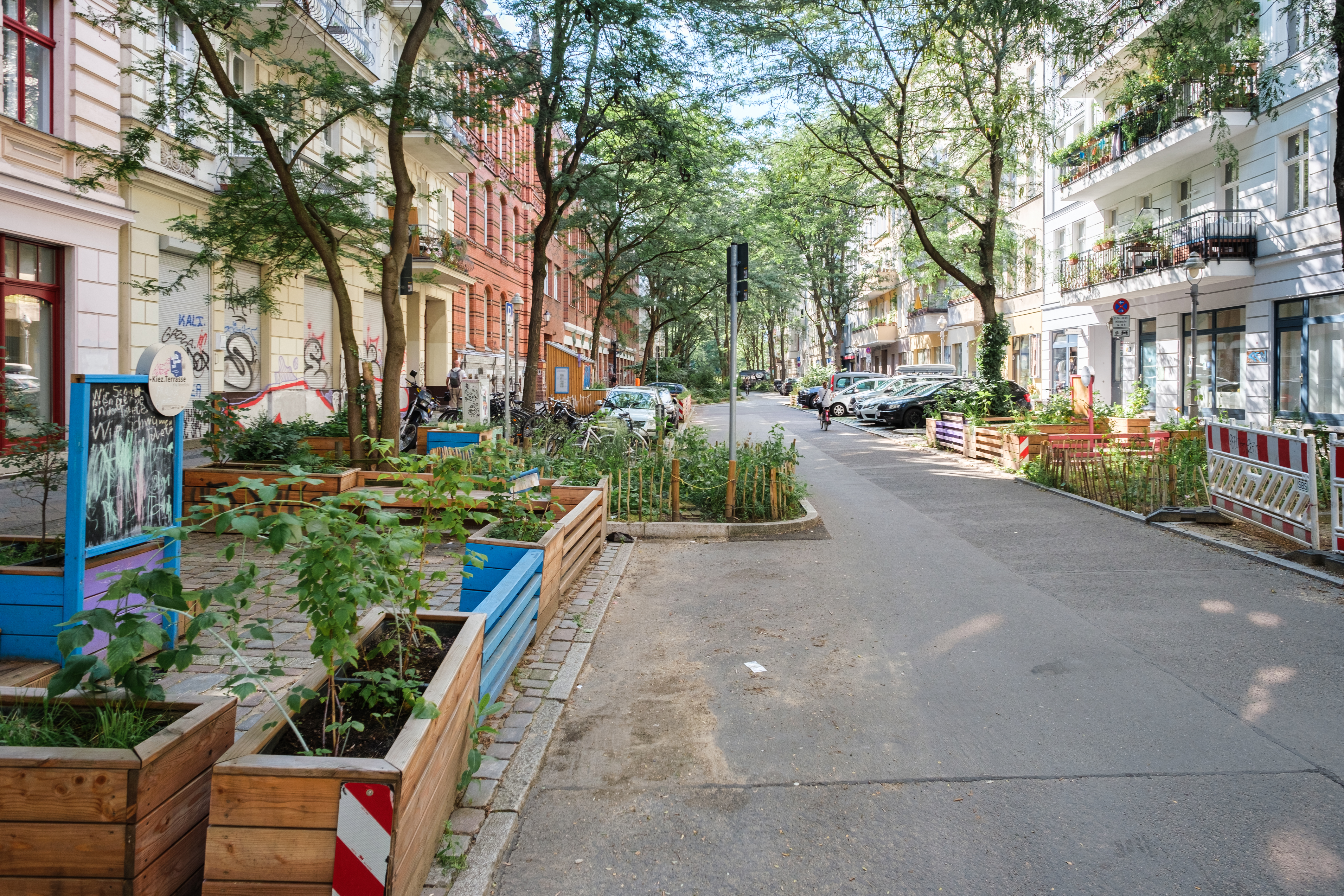
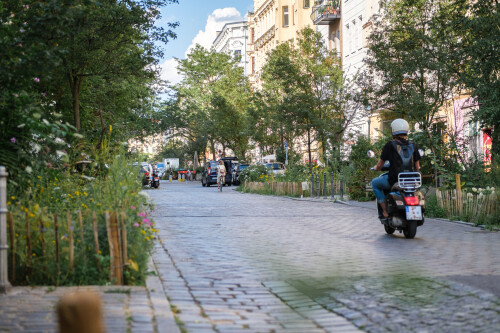
The project was implemented in two stages. In the core area (Böckhstraße and Graefestraße), some parking spaces were de-sealed, parklets and neighbourhood terraces were installed. In the broader area, Jelbi shared-mobility stations were set up, and loading and delivery zones were established. At Hohenstaufenplatz, through traffic for motorized vehicles has been blocked so that the traffic has calmed in the neighborhood. The Berlin Social Science Centre (WZB) provided independent scientific monitoring, while the civil society organisation paper planes e.V. led community engagement.

The district authority regards the measures in the core area as a success: the traffic-calmed zone is now more clearly recognisable, the quality of public space has improved, and sightlines have been significantly enhanced which contributes to traffic safety. A survey of 1,341 residents confirmed broad public support for the measures.

Sustainable Development Goals
Ensure healthy lives and promote well-being for all at all agesMake cities and human settlements inclusive, safe, resilient and sustainableTake urgent action to combat climate change and its impacts
City
Berlin, Germany
Size and population development
In 2019, the municipality of Berlin had a population of 3,669,491 inhabitants, making it the most populous city in the European Union (EU). The larger metropolitan area has about 5 million inhabitants.
Population composition
According to estimations, about one third of Berlin’s population was foreign born or has a migratory background. These inhabitants originate from other parts of the EU—such as Poland, Italy or Bulgaria—as well as from countries outside of the EU, such as Syria, Vietnam or the United States of America. The largest non-native population comes from Turkey: In 2019, more than 107,000 Turkish nationals were registered as inhabitants of Berlin.
Main functions
Berlin is the capital and largest city of Germany. As a city-state it is also one of the country’s 16 Länder, as the federal states are called in Germany. Situated approximately 112 miles (180 km) south of the Baltic Sea, the city lies in the wide glacial valley of the Spree River, which runs through Berlin’s centre. The city extends over an area of 891.7 square kilometres and stands at an average altitude of 34 meters above sea level. After the reunification of Germany and East and West Berlin in 1990, the unified Berlin was re-established as the country’s capital (replacing Bonn, the former capital of West Germany). In 1999, large parts of the Federal Government and the German Bundestag finally moved back to Berlin. Berlin is a city of great historical significance, which becomes evident considering the amount of historical landmarks that visualize the city’s history. Some of the most important landmarks include the Brandenburg Gate (built in 1793), the Reichstag Building (which dates to 1884), remnants of the Berlin Wall (taken down on the 9th of November 1989) or the Holocaust memorial (inaugurated in 2003). Berlin is also a famous cultural hub, known for its world-class museums, theatres, operas and concert halls as well as its vibrant club scene and street art. Finally, the Brain City Berlin is a leading location for science and research. It is home to a number of prestigious universities such as the Freie Universität Berlin, the Humboldt Universität zu Berlin and the Technische Universität Berlin, with more than 35,000 students each as well as renowned research institutions and think tanks.
Main industries / business
As the fourth largest economy of the world, Germany has a wide array of prestigious industries. Berlin is home to a diverse mix of economic activities: state-owned enterprises, creative industries, automotive manufacturers, (digital) media corporations, high-tech and telecommunication companies as well as multiple digital pioneers that flourish in the city’s vibrant start-up scene. Tourism is constantly growing and brings about 14 million visitors (2019) to the city every year.
Sources for city budget
Berlin draws its budget for public expenditure largely from taxes, federal transfers, fees, fines and operating revenues. It is spent not only to provide high quality public services, but also to boost the city’s private sector, civil society engagement and cultural life.
Political structure
The city-state Berlin is governed by the Berlin Senate, which is comprised of 10 senators, and the Governing Mayor. As the capital of Germany, Berlin hosts the Bundesregierung (federal government), the Bundestag (federal parliament) and the Bundesrat (the parliamentary chamber of the 16 Länder). Each of the 16 Länder has a representation in Berlin. On many political issues, the Länder have co-legislative powers vis-à-vis the Federal government. Moreover, Berlin hosts embassies from more than 120 countries from around the world.
Administrative structure
Berlin is administrated by the Senate and its 12 districts or boroughs (Bezirke). The Senate is the city’s central administration, in charge of city planning, public policy, and the regulation of public and private spheres. The district administrations have some decentralized public functions, with reasonable differences between the various localities.
Website
http://www.berlin.de

The Graefekiez is an inner-city neighbourhood of pre-war residential buildings in Berlin's Friedrichshain-Kreuzberg district, with a population density of approximately 30,000 residents per km². Despite this density, car ownership is low: only 182 cars per 1,000 residents, compared to a Berlin-wide average of 335. Also, car use is very low. In the district of Friedrichshain-Kreuzberg only 8.4 % of resident trips are made by car.

Since the 1980s, the area has been formally designated a “traffic-calmed zone”. In practice, however, the street layout remained conventionally divided into pavements, parking strips and carriageways, without the physical redesign required by the administrative regulations. This "built contradiction" created ambiguous and dangerous conditions.

A traffic count carried out in Böckhstraße on 15 December 2022 found that fewer than 10% of vehicle drivers observed the legally required walking pace (7 km/h); on average, speeds exceeded this limit by three to four times. Parked vehicles severely restricted sightlines and movement space for pedestrians and cyclists, particularly dangerous for school children attending the four schools located within the neighbourhood.

The district assembly commissioned the district authority, on the initiative of B'90 Die Grünen/SPD, to pursue the following main objectives:

  • Improving road safety for schoolchildren (particularly at Lemgo Primary School, Böckhstraße)
  • Strengthening climate resilience through de-sealing and green infrastructure (sponge city approach)
  • Establishing loading and delivery zones for commercial traffic
  • Expanding shared mobility (bicycles, cargo bikes, car-sharing via Jelbi)
  • Improving the quality and liveability of public space

Political starting point

A planning motion submitted to the district assembly in April 2022 and adopted with amendments in June 2022. It tasked the district authority with carrying out a scientifically monitored field experiment in cooperation with the WZB. After thorough legal and technical review the project was extensively modified and launched with a smaller scope on 14 March 2023 under the motto "Step by Step, More Space".

Legal review and revised approach

The original concept envisaged converting approximately 600 car parking spaces across the entire neighbourhood. Following a legal opinion commissioned by the WZB, it became clear that a district-wide traffic experiment would only be legally permissible where a specific and demonstrable hazard could be established — which could not be done for the Graefekiez as a whole. The concept was therefore revised into a two-stage approach.

Stage 1: Core area (Böckhstraße / Graefestraße)

In the summer of 2023, the following measures were implemented in the core area:

  • De-sealing of car parking spaces for planting by local residents (soil replacement to a depth of 30 cm was required due to ground contamination; construction was delayed by approximately four weeks as a result)
  • De-sealing of parking spaces to create a gravel surface for recreational use
  • Installation of parklets (neighbourhood terraces, an outdoor classroom) by the "Zukunft Straße" project, developed in co-creation with local schools and nurseries
  • Designation of activity spaces for special-use permits
  • Establishment of an "Open Table" in Graefestraße as a demonstration use
  • Installation of 13 Jelbi points and 5 Jelbi stations (BVG) across the neighbourhood, reachable within 100–200 m; residents received a €20 voucher by post upon launch
  • New bicycle parking facilities
  • Establishment of loading and delivery zones at 8 locations with a 30-minute disc parking requirement, providing a total capacity of approximately 32 vehicle spaces; HGV zones of 20 m and courier/parcel delivery zones of 10 m

Stage 2: Hohenstaufenplatz (from August 2025)

The next construction phase began in August 2025: a roughly 50-metre section of Schönleinstraße is being redesigned. Planned measures include: bollards to prevent motor vehicle through traffic (whilst maintaining cycle access), barriers to allow access for residents' rear courtyards and emergency vehicles, de-sealing along existing tree pits, new benches and bicycle stands, and potentially additional space for outdoor hospitality. Loading and delivery traffic will be accommodated on adjacent areas.

Scientific monitoring and community engagement

Alongside the physical measures, the WZB and paper planes e.V. independently conducted research and participation processes. These included quantitative surveys, focus groups with business owners, older residents and people with disabilities, thematic workshops (on water management and noise/disorder, among other topics), and the citizen science project CompAIR, which measured air quality and traffic flow. The research and participation reports were completed in April 2024.

Furthermore, the initiative Kiezlabor from Technologiestiftung Berlin stopped by for a week of discussions and citizen engagements in September 2023.

Key actors

  • District Authority Friedrichshain-Kreuzberg / Streets and Green Spaces Office (SGA): implementation of traffic and street redesign measures
  • Berlin Social Science Centre (WZB): scientific monitoring and research report
  • paper planes e.V.: community engagement and participation report
  • Berlin 21 e.V.: support for participation formats
  • Naturfreunde Berlin e.V.: support for implementation measures (including environmental detective workshops for children)
  • BVG (Jelbi): provision of shared-mobility stations
  • German Aerospace Centre (DLR): research partner
  • RIFS Potsdam: research partner
  • Nürtingen-Geislingen University of Economics and Environment (HfWU): research partner
  • CompAIR / inter 3: citizen science project (air quality and traffic)
  • Berlin Senate Department for the Environment, Mobility, Consumer Protection and Climate Action: funding

The costs of the measures implemented by the district authority amounted to €112,759, financed through the Senate Special Programme for Urban Beautification (discontinued after 2023).

The costs of the research (WZB) and community engagement (paper planes e.V.) were not borne by the district authority, but were funded through third-party grants secured by the participating institutions, including:

  • Stiftung Mercator
  • Deutsche Bundesstiftung Umwelt (German Federal Environmental Foundation)
  • Climate Change Center Berlin
  • WZB (own funds)

As of 2026, no funding is available in either the district or the state budget for extending the project to further areas of the Graefekiez. The changed priorities of the Senate administration and associated budget cuts present an additional obstacle to continuation.

The district authority regards the measures implemented in the core area as a success:

  • The traffic-calmed zone is now more clearly recognisable and can be used more effectively by pedestrians
  • De-sealed surfaces function as green infrastructure and have been embraced by the local community
  • Jelbi stations have significantly reduced the number of shared-mobility vehicles parked on pavements; within the first six months (October 2023 to February 2024), 20,000 rentals were recorded via Jelbi in the Graefekiez
  • Loading and delivery zones provide legal stopping opportunities without obstructing traffic (approximately 32 spaces at 8 locations)
  • Sightlines and safe street use have been considerably improved through neighbourhood terraces, de-sealed surfaces and bicycle stands
  • The social and recreational function of the core area has been significantly strengthened

Public acceptance according to WZB survey:

  • Greening of car parking spaces: >50% rated "very good", 25% opposed
  • Loading and delivery zones: >60% in favour, only 12% opposed
  • More seating: 43% in favour, 27% opposed
  • In a separate survey in 2021, two thirds of respondents across the entire district had rated the reallocation of parking spaces as an urgent matter — approval levels remained stable despite intense public debate.
  • Legal constraints: At the time of the project, German road traffic law (StVO) required that a specific and demonstrable hazard be established before parking spaces can be reallocated. This could not be proven for the neighbourhood as a whole, only for individual sections (e.g. in front of Lemgo Primary School). The original concept had to be fundamentally revised.
  • Soil contamination: Soil samples taken in Graefestraße revealed contamination in the subsoil, requiring replacement of material to a depth of 30 cm and delaying the start of construction by approximately four weeks. This illustrates the practical challenges of de-sealing in a densely built inner-city environment.
  • Funding: Implementation was only possible through the Senate Special Programme for Urban Beautification, which was discontinued after 2023. No funding is available for an extension of the project.
  • Staffing capacity: The project placed enormous demands on capacity across the district authority; further measures outside the core area could not be implemented.
  • Open space plan not completed: The project was intended to produce an open space plan for the public realm, which was not completed. As a result, a planning basis for extending the measures across the entire neighbourhood is still missing.
  • Social inclusion: Focus groups revealed that older residents and people with disabilities expressed concerns about their established mobility patterns. The Werner-Düttmann housing estate was barely reached by the participation activities.
  • Political context: The changed priorities of the new Senate administration and associated budget cuts make continuation more difficult.
  • The legal framework for road traffic must be assessed at an early stage. Road traffic law, as a body of law primarily concerned with hazard prevention, at the time of the project was only partially suited to street redesign driven by urban planning objectives.
  • A two-stage approach — beginning with a core area before developing an overall concept — proved to be a legally more robust path and allowed experience to be gathered before scaling up.
  • The combination of independent scientific monitoring (WZB) and autonomous community engagement (paper planes e.V.) generated valuable insights and strengthened the legitimacy of the process.
  • De-sealing measures and shared-mobility provision can be effective even at a small scale and can be embraced by local communities even in areas where car ownership is already low.
  • Broad communication in multiple languages, in plain language, and across a range of channels is essential to reach diverse population groups.
  • Long-term, mainstreamed funding and sufficient staffing in the streets and green spaces office are prerequisites for sustaining and scaling up the approach.
  • The project has developed a transferable model: the tested space allocation framework (including 26% green space, 25% pedestrian and social space, 7% shared mobility) can serve as a template for traffic-calmed zones in other urban neighbourhoods.
  • Comparable approaches exist in other cities (e.g. "Ottensen macht Platz" in Hamburg) showing that cross-project comparison and exchange is valuable for cities considering similar interventions.

District Authority Friedrichshain-Kreuzberg. Project page.

District Authority Friedrichshain-Kreuzberg. Project news.

BVV Friedrichshain-Kreuzberg. Consolidated document including project reports.

Categories

On Map

The Map will be displayed after accepting cookie policy

Want to know more about this project?

use Content Manager
Berlin, Germany

use Content Manager

Individual | Content Manager of the use platform

Photo gallery